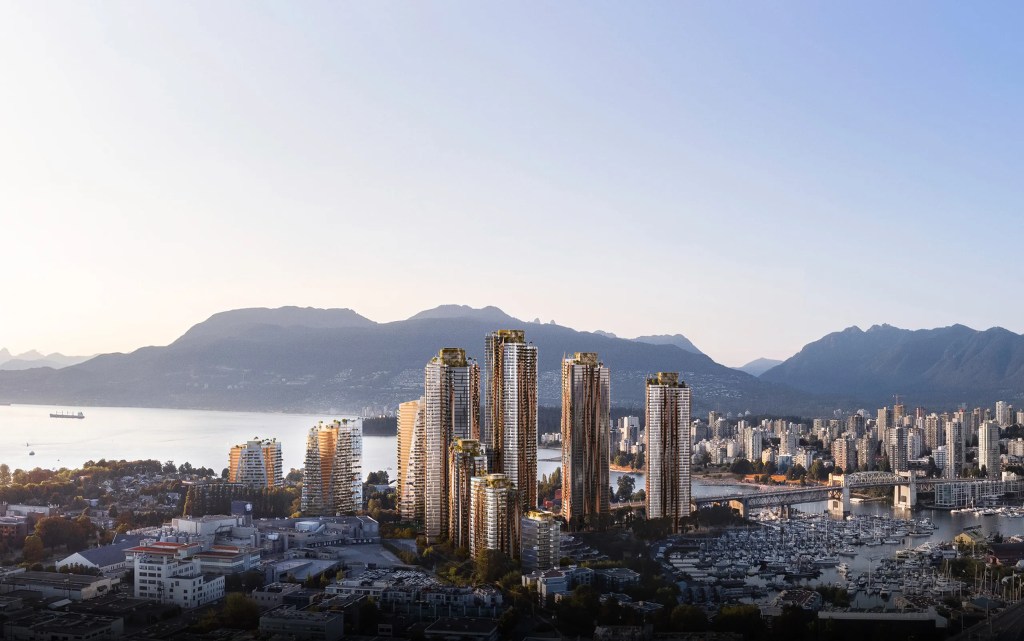
How small is too small?
By Vincent Nguyen | July 16, 2026 7:05am PST

Nano-studio from UBC residence
For several years, I’ve got to experience what it’s like to work for non-profit organizations that help the vulnerable population.
From the very unfortunates in homeless shelters, to young adults in transition housing, to families, seniors, and people with disabilities in subsidized housing. It was a unique perspective seeing people of various demographics across different stages of life within these housing programs.
But as great as it was seeing many of the people who make up our wonderful communities, I can’t really say the same for the types of housing that we have in our society.
Where do I begin…
For example, why is the cost of rent so high for just the smallest standard suite, aka a studio? (roughly 350-400 sq. feet)
And moreover, how come we don’t have a lot more smaller standard suites like micro-studios (~250-300 sq. feet) and even nano-studios (~150-200 sq. feet) around as lower rental options?
When it comes to solving housing affordability and shortages, why not build more smaller sized units that are reasonable to live in and for people to comfortably rent instead of building more houses and condos that people can’t afford?
In Metro Vancouver Canada for example, where I reside, renting a studio would be somewhere around ~$1800 to $3000+. It’s quite pricey and falls in line with many recognized cities in North America.
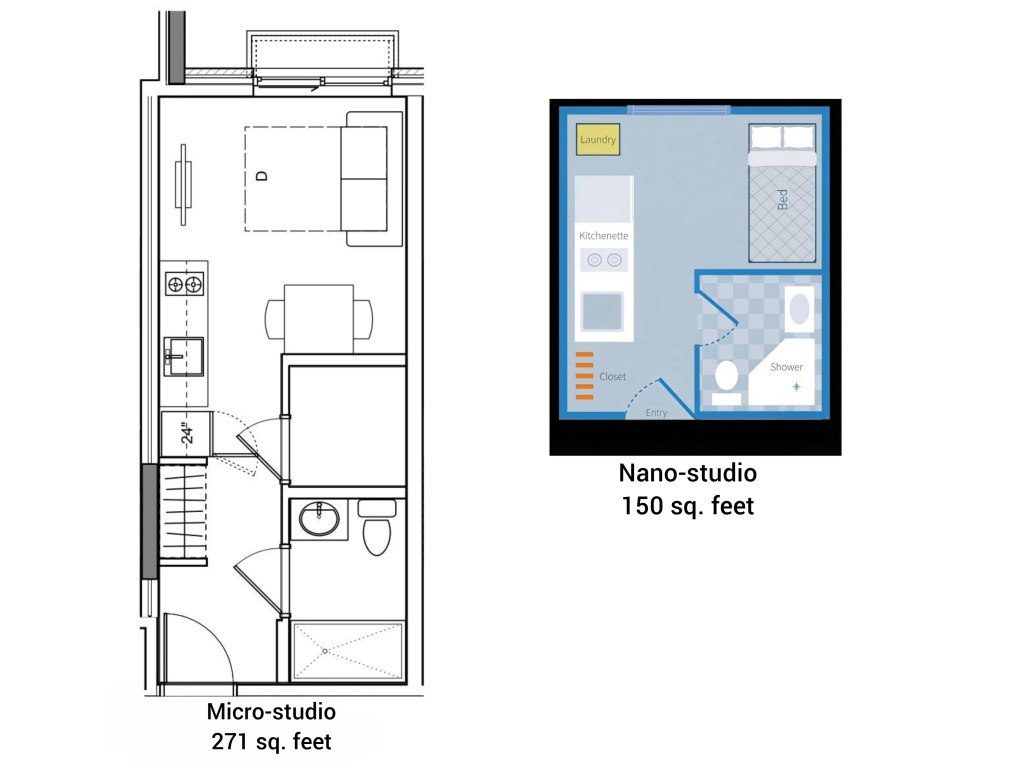
Left layout from Bob & Michael’s Place | Right layout from UBC residence (slightly altered)
I think there has to be a better solution than just relying on housing programs, splitting rent with other people, or still living with the parents for that matter in order to make living affordable.
Waiting lists, eligibility, and requirements (among other things) can be a hassle to deal with for housing programs.
What if someone just wants a nice compact living space for themselves without having to pay a noticeable amount of their income towards rent every month and without involvement of housing programs, would it be possible for them to find?
I wouldn’t say it’s impossible, but it’s certainly very close to it for the majority who wants it.
I mean, I consider myself very lucky in terms of my housing situation, being able to live in a modest sized studio all by myself is just amazing and I’m more than grateful. It almost feels unfair and a luxury to be doing so, and by no means am I financially privileged either. I probably just lucked out and found it at the right time.
The pros of it isn’t just that I’m living by myself either.
It helps tremendously that the rent I pay is hundreds of dollars cheaper than the typical asking price, which I’m advocating for, but also my place isn’t a housing program, the building is quite new only about four years old, and it isn’t a condo owned by an individual investor/owner (which I despise), to name a few.
The feeling of independence that I get from not receiving help from the government or leaning on anyone financially is nice.
The amount of peace and quiet I get without having roommates is something that I hopefully would never have to negotiate ever unless I get into a serious relationship.
It’s astonishing what affordability and true privacy can do for my quality of life. Mentally, physically, spiritually, and emotionally.
So why can’t it be like this (or better) for anyone else who wants it? Or is willing to compromise in size to obtain?
Modern Day Solutions?
Personally, I feel like if China has figured out a way to assemble quality housing faster with prefabricated housing, and how prefabricated housing is starting to become a thing here in North America, specifically in Canada, then there should be a way to solve this housing issue eventually.
In fact, it’s actually just a matter of when, not if, based on this comprehensive report last year.
Hopefully prefabricated housing can be ramped up sooner rather than later, but realistically speaking, I’m not expecting anything drastic in the near future only because housing development seems to be a culmination of barriers and complexities in Canada.
It’s frustrating because we obviously need more housing, yet we’re moving at such a snail’s pace.
Types of Housing
The way how I look at housing in our society today, specifically within urban areas and the suburbs of North America is as follows:
We essentially have four different types of homes available and they take up a good chunk of the pie, if not all.
In no particular order, the first are houses that you can buy where ownership and mortgage is involved. Basically, big and long term investments. (single and multi-family detached houses, townhouses, etc)
The second is very similar to the first except with purchasable condo units. (primarily high-rise/urban skyscrapers, but not uncommon with mid to low-rises)
The third is rentals for anyone to lease and not buy. (various suite sizes in basically most residential housing structures and buildings)
And finally, the fourth is housing programs, where the government and non-profit organizations come into play to help low to modest income and vulnerable people. (high to low-rises, and a slight mix of some other housing structures)
In my opinion, there needs to be a fifth type of option.
This fifth type should be high-rise compact housing, and they need to be mass produced at a scale and scope similar to condo towers to really take up a good chunk of the pie.
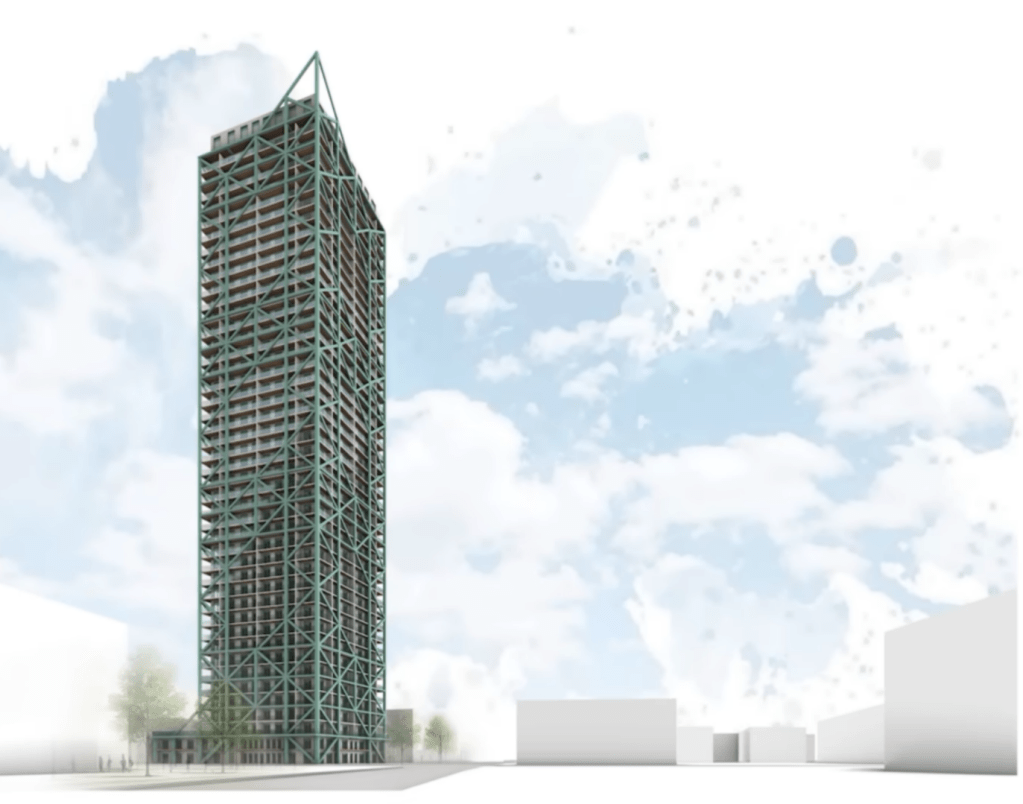
Prefabricated high-rise concept – System Eco(n) by architect Carter McHugh
So what should these high-rise compact housings look like exactly and who should they be for?
[The What]
High-rise compact housing should be purpose-built rental buildings of at least 40 storeys or higher like urban skyscrapers, and all of the suites within them should ONLY contain micro-studios and/or nano-studios.
They should be rented somewhere in the ballpark of $800-$1200 a month depending on its size.
There should be one or two of these high-rise compact buildings in each urban hub (cities’ downtown area) to start out, and then eventually have one or two built within walking distances of metro stations and transit hubs.
The reason they should be 40 storeys or higher is to reach adequate demand of a large or growing population.
And the reason for purpose-built rentals is because having the entire building owned and managed by a single corporate developer would be much better for renters than having it as a condo with each unit owned by individual investors/landlords.
Having it as a condo would cause rent inconsistencies and a higher risk of longevity and uncertainty issues if the owner sells the unit, wants to move in, or other precarious reasons.
The ground and second floors could be made for retail stores and additional parking to benefit everyone: the tenants, surrounding community, and corporate developer running it.
These purpose-built rentals could be made via the prefabricated method or the traditional method.
The prefabricated way is proven to be possible thanks to an architectural submission for a recent low-carbon contest called Decoding Timber Towers — System_Eco(n), a 42 storey design (images below).
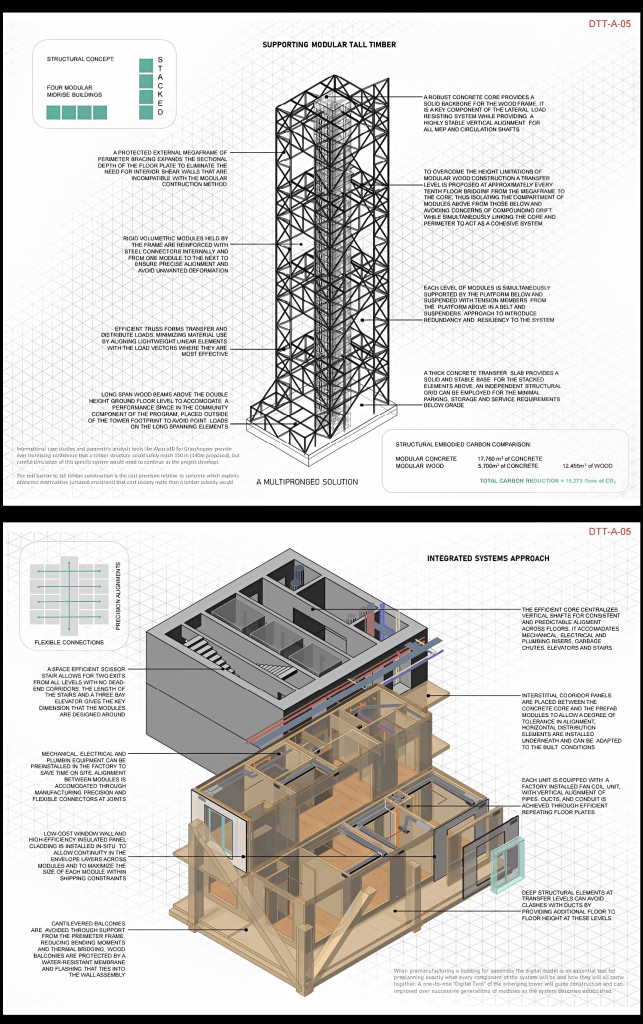
[The Who]
These high-rise compacts would be perfect for single people who want to live alone in their own private units.
No shared laundry, no shared washrooms, no shared dining area — just personal space and independence like a regular person and tenant.
All that is needed is an income to reliably pay rent every month on a lease agreement like all purpose-built rentals you’d find today.
There wouldn’t be any extra hoops you’d have to jump through, so no need to worry about eligibility and requirements from housing programs, nor worry about longevity and inconsistency issues from single landlords/owners.
Peace of mind.
On a side note, I could also make the case that couples are more than capable of living comfortably in a micro-studio if they really wanted to.
Conclusion
I get that these high-rise compacts might exist somewhere in the world already, perhaps in very limited pea-sized quantity, but as far as North America is concerned, there’s none that I’m aware of that even comes close to satisfying demand.
I think it’s paramount that we seriously consider these high-rise compacts as a norm going forward and have them built extensively if they ever come to fruition.
They’d be a huge net gain for society if they were more common and readily available throughout our neighbourhoods because people who’d want to live alone wouldn’t have to resort to undesirable alternatives due to the lack of options, which in turn may affect their quality of life and ultimately affect others around them.
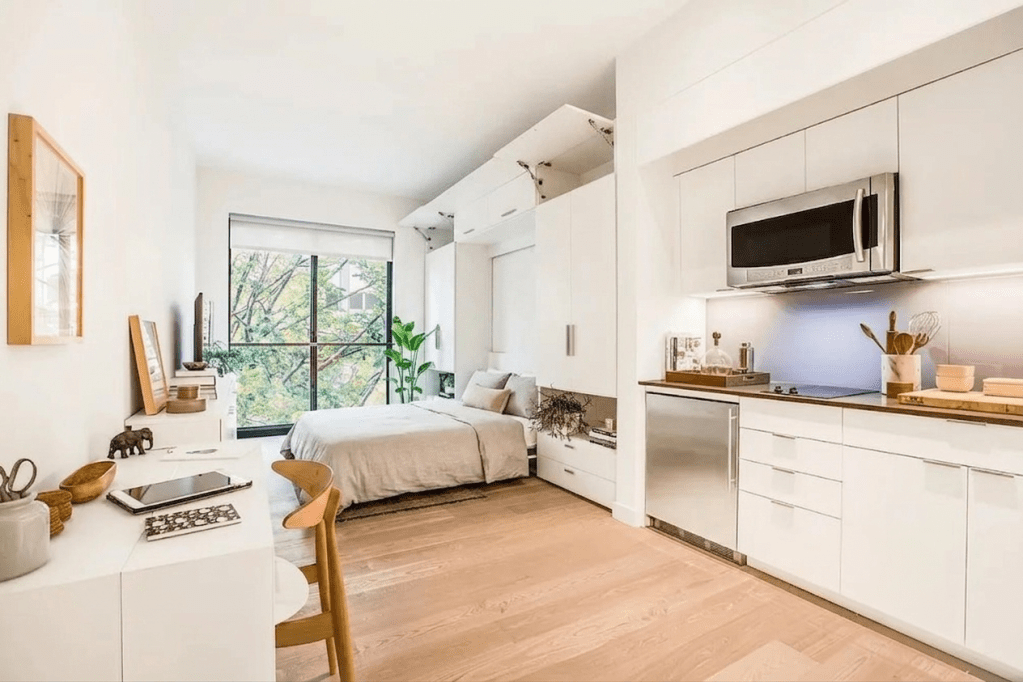
Carmel Place in New York
Food for Thought
And look, I’m not saying we should stop building houses and condos for people to buy as there will almost certainly be a market for those and any other type of housing we currently have. What I’m suggesting is, let’s squeeze in these high-rise compacts into the mix to have more of a fighting chance for better options and choices for ourselves.
We’re obviously living in a much different time than the past.
The following statistics should indicate the need for high-rise compact housing:
Color codes: (Canada) (US)
“In Canada, there’s been a drop in the number of people living together as couples from 1981 to 2021, according to Statistics Canada.” (CBC article link 1)
“While the number of Canadians living alone is now at a record high, Canada has a relatively small number of single-person households compared to other wealthy nations. All other countries in the G7, apart from the U.S., have more single-person households than Canada.” (CBC article link 2)
“The 663,835 roommate households reported in the new census represent a 54 per cent increase between 2001 and 2021, and a 14 per cent increase since 2016. Statistics Canada said the challenges associated with finding and paying for housing have contributed to that shift in household makeup.”
“After trending upward for the past 20 years, the number of young adults aged 20 to 34 living with at least one parent remained constant in 2021 at 35 per cent, the same level it was in 2016.”
“Statistics Canada said the number of Canadians living alone reached a record high of 4.4 million in 2021, up from 1.7 million in 1981.”
“In 1941 just six per cent of Canadians lived alone. By 2016, single-person households had become the dominant household type, making up 28 per cent of the total. The number of single-person households rose again in 2021, to 29 per cent.”
“Statistics Canada said that growth in single-person households will affect the housing market over time. Almost six in ten single-person households are in apartments, while 61 per cent of households with two or more people live in detached houses.”
“According to data from the Pew Research Center, 30% of people are not married, living with a partner or in a committed romantic relationship.” (Forbes article link)
“The share of people living alone increased every decade from 1940 to 2020.” (Census Bureau link)
 Vince
Vince 
Leave a comment